A newly released 2024 Inspector General report: the Pentagon office put in charge of military deception had no charter for it
In May 2024, the Defense Department's Inspector General finished a Top Secret evaluation of military deception. Military deception means actions that mislead enemy commanders into choices that help US operations. The report found that the office put in charge of deception in 2023 had no formal charter for it. The Inspector General never published the report, not even in redacted form. A Freedom of Information Act request has now released 45 pages of it, heavily redacted. No coverage of their contents has been found.
The story
After the September 11 attacks, the Pentagon set up an Office of Strategic Influence. In February 2002, the New York Times reported plans for it to spread false information abroad. Days later, Defense Secretary Donald Rumsfeld announced that the office would close.
On March 1, 2022, the Pentagon created an Influence and Perception Management Office, or IPMO. It reports to the Under Secretary of Defense for Intelligence and Security. The Pentagon never announced it. Ken Klippenstein revealed it in The Intercept in May 2023 and compared it to the 2002 office. Budget notes quoted in that article describe its subject as "perception management (reveal and conceal) matters."
In November 2022, William Arkin revealed the Inspector General's evaluation in his newsletter, Government Secrets. Its stated aim was to judge how "effectively" the combatant commands planned deception. Combatant commands are the military's large joint headquarters, such as Central Command. Arkin predicted the inspectors would ask whether deception works. They would not ask whether peacetime deception makes sense.
The dispute
Critics of Pentagon deception and influence work have raised two concerns.
- Reach. The 2002 office closed amid reports that it would plant false stories abroad. A 2004 Times article warned that such falsehoods "could easily be repeated by American news outlets." IPMO's unannounced start revived that worry in 2023.
- Legitimacy. Arkin's question was whether deception in peacetime makes sense at all.
The released pages answer neither. They judge how well deception is run, as Arkin predicted. Their complaint is the opposite of overreach: a program without a clearly defined owner.
What the new record adds
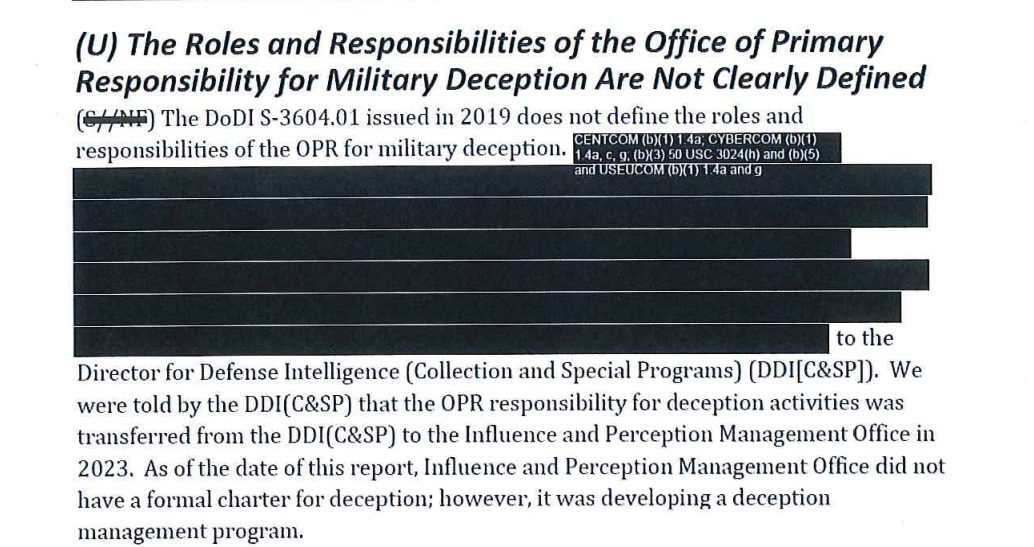
- No defined owner. One section is titled "The Roles and Responsibilities of the Office of Primary Responsibility for Military Deception Are Not Clearly Defined." The office of primary responsibility is the one accountable for the program. A 2019 Pentagon instruction "does not define" that office's roles, the report says.
- A recent handoff, without a charter. The 2019 instruction gave deception duties to the Director for Defense Intelligence (Collection and Special Programs), a Pentagon intelligence official. In summer 2023 they moved to IPMO. "As of the date of this report, Influence and Perception Management Office did not have a formal charter for deception," the report says. It "was developing a deception management program."
- No response to the fix. The first of four recommendations asks the Under Secretary to name IPMO formally as the office in charge. The Under Secretary, the IPMO Director and one redacted official "did not provide a response to the report."
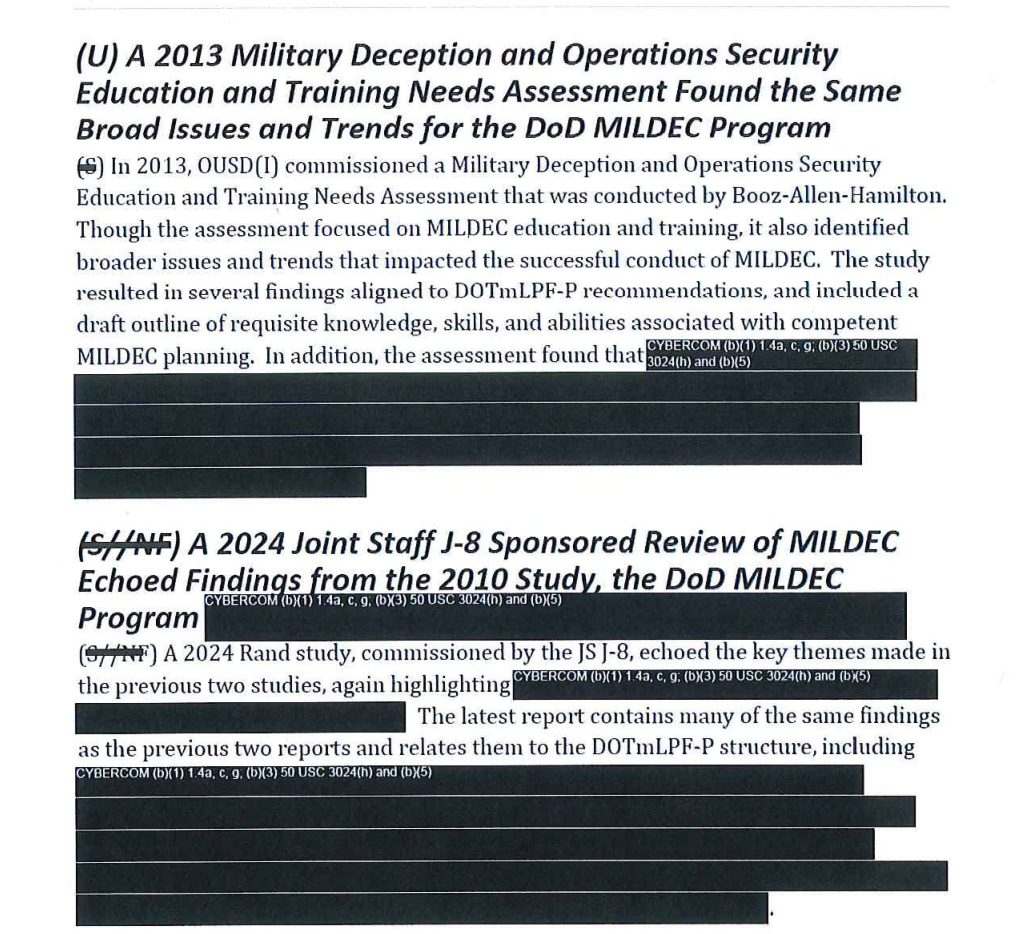
- Fifteen years of repeated findings. The Pentagon commissioned three studies of the deception program: by RAND in 2010, Booz Allen Hamilton in 2013 and RAND in 2024. The 2024 study "contains many of the same findings as the previous two reports." What those findings are is redacted. Another recommendation asks for a plan to act on them.
- Oversight, then a redacted "However." The Joint Staff office that runs joint deception "provided appropriate oversight," the report says. The next sentence begins "However, we determined that the DoD's Joint MILDEC program," and the rest is redacted.
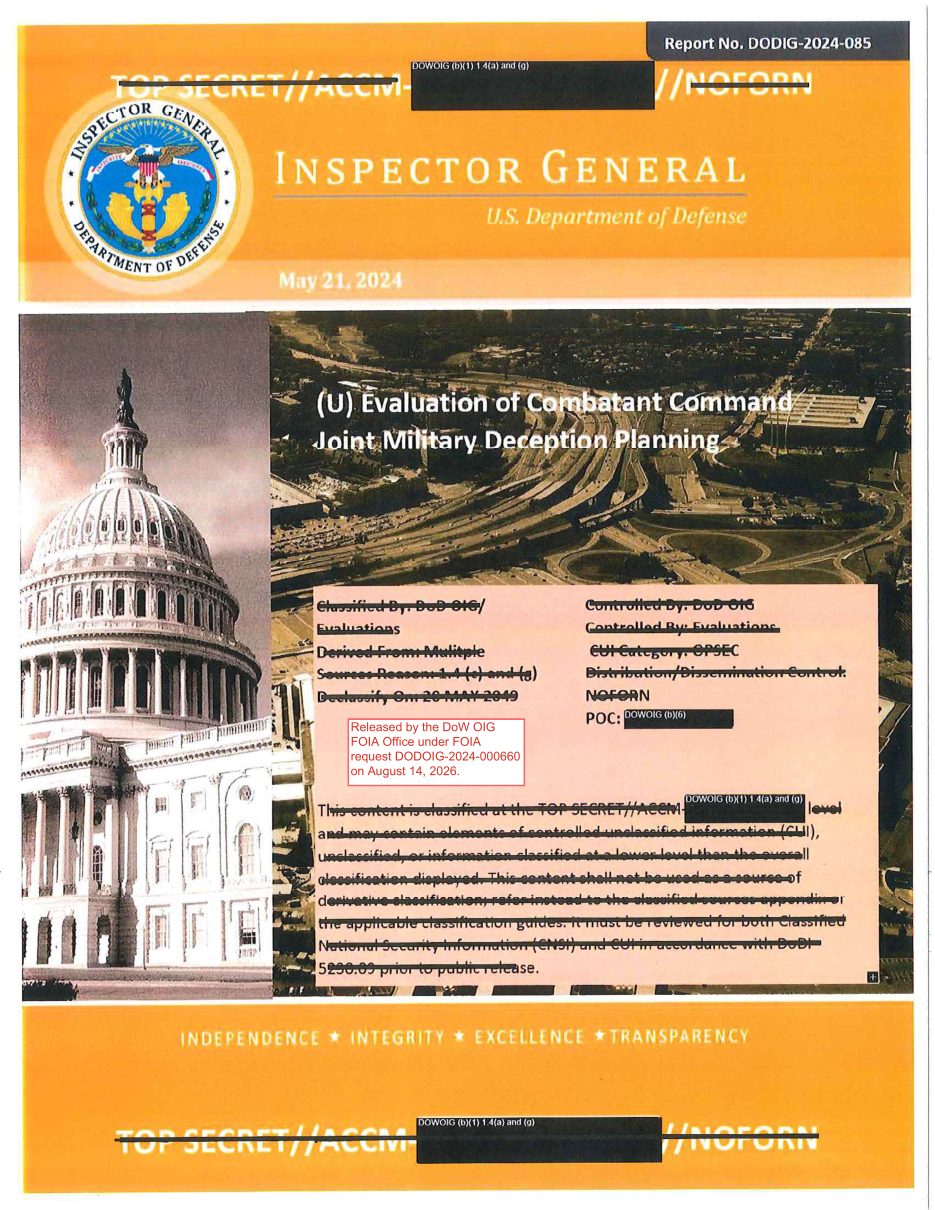
The release also shows how closely the subject is held. The report is marked Top Secret, with an extra access control on top. Before release, the Inspector General consulted the Joint Staff, Central Command, European Command and Cyber Command.
It does not settle the dispute. The findings about the commands' actual deception plans are redacted. So are the problems the three studies found. Whether IPMO now has a deception charter is not public.
What comes next
An appeal filed on October 21, 2026, challenges redactions made to protect internal deliberations. It argues that such redactions are hard to justify in a final report. Its result will be posted here.